
Refugee Health Assessment Template
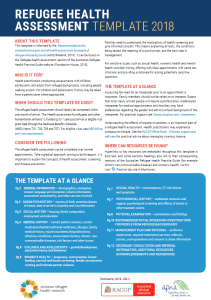
The Refugee Health Assessment Template can be used to assist GPs and nurses to offer a comprehensive post-arrival health assessment to every child, adolescent and adult from a refugee background who is new to your care, preferably within one month of arrival.
Always use person-centred care principles that consider the impact of past trauma. Use language and gender-appropriate interpreters.
Visit the Australian Refugee Health Practice Guide for further information including approach to care for conducting refugee health assessments as well as ongoing care.
Conducting the assessment
- The refugee health assessment can be completed over several appointments. Take a gradual approach, aiming to build rapport. It is important to explain the concepts of health assessment, screening and disease prevention.
- Families need to understand the implications of health screening and give informed consent. This means explaining all tests, the conditions being tested, the meaning of a positive test, and the next step in management.
- For sensitive issues such as sexual health, women’s health and mental health, consider timing, offering individual appointments with same sex-clinicians and providing a rationale for asking potentially sensitive questions.
- Assessing the need for an interpreter prior to an appointment is important. Family members should not be relied on to interpret. Expect that most newly arrived people will require a professional, credentialed interpreter for medical appointments and that they may have preferences regarding the gender and ethnic/cultural background of the interpreter. For practical support see Communication and Interpreters.
Practice tip: The ‘Health assessment for refugees and other humanitarian entrants’ is funded up to 1 year post arrival or visa grant date through the Medicare Benefits Schedule (MBS) (Items 701, 703, 705 and 707). The assessment can be completed over a number of consults.
Version history
V5.1 (2026) can be downloaded via the link below and includes updated weblinks and minor formatting changes from the last version V5.0 published in 2018. Minor updates are listed on the last page of the assessment under ‘version history’. V5.1 represents phase 1 of a broader update currently underway.
The Refugee Health Assessment is being updated as part of the Refugee Health Practice Guide – Sixth edition – please click here for details and contacts to be involved.
Refugee Health Assessment Template
The Refugee Health Assessment Template 2018 is informed by the Recommendations for comprehensive post-arrival health assessment for people of refugee-like backgrounds’ (ASID/RHeaNA, 2016). It considers the primary care context including workflow and whole of practice approaches and aims to assist primary care providers to deliver high quality on arrival health care for people from refugee backgrounds.
Visit