
Bilingual Mental Health Services Glossary
Developed in collaboration with the Centre for Culture, Equity and Health (CEH), the bilingual glossary explains common mental health terms used in the Victorian mental health system. It is designed to help people better understand the mental health system, their rights, and the roles of different professionals involved in care and support.
About the Bilingual Mental Health Services Glossary (the Glossary)
The Bilingual Mental Health Services Glossary is a plain language, bilingual resource for mental health terms and service roles.
It supports workers, community leaders, and service users to develop a shared understanding of mental health terms, helps to reduce stigma, and improves referral pathways.
Importantly, it also helps strengthen culturally informed practice, so services can better support people of refugee and asylum‑seeking backgrounds.
There are 45 key terms, alphabetised in English on the left-hand side, and translated into one of 16 different languages on the right-hand side. It can be printed or used digitally.
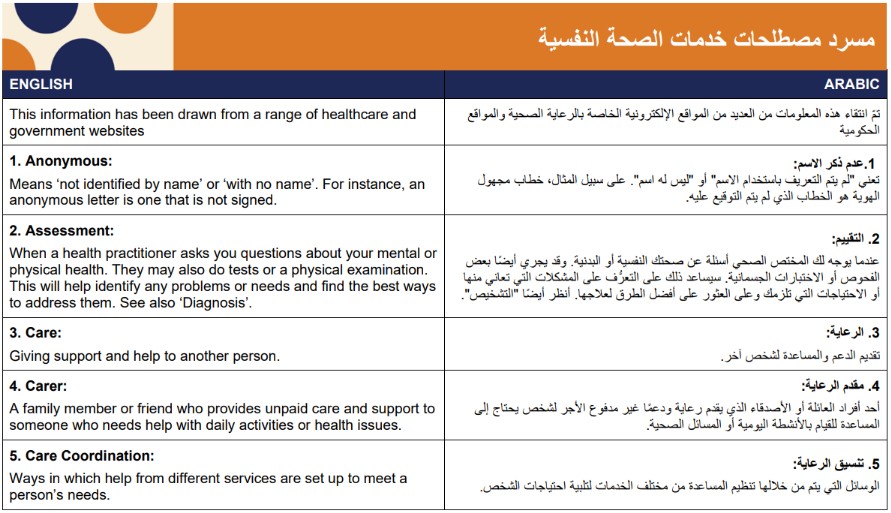

How to use the Glossary

As an individual
The Glossary can help you understand new terms that might come up in health appointments, empowering you with knowledge to feel in charge of your healthcare journey.

As an interpreter
Use the Glossary to clarify terms in preparation for appointments, as a handy reference during your interpreting sessions, and in collaboration with mental health practitioners to develop a shared language.

As a healthcare provider
Glossary Translations Library
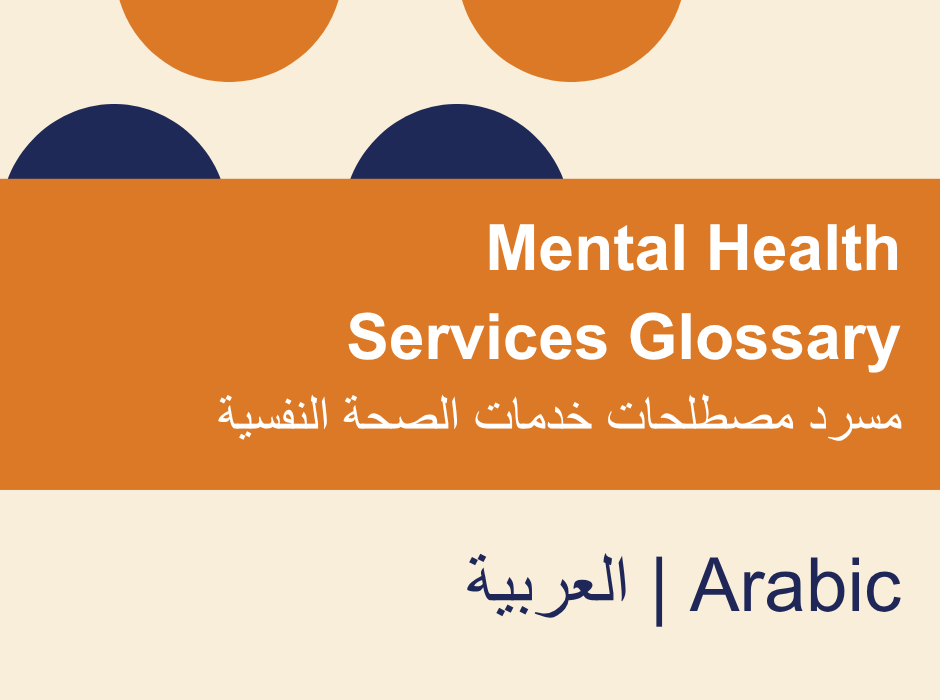
Arabic | العربية
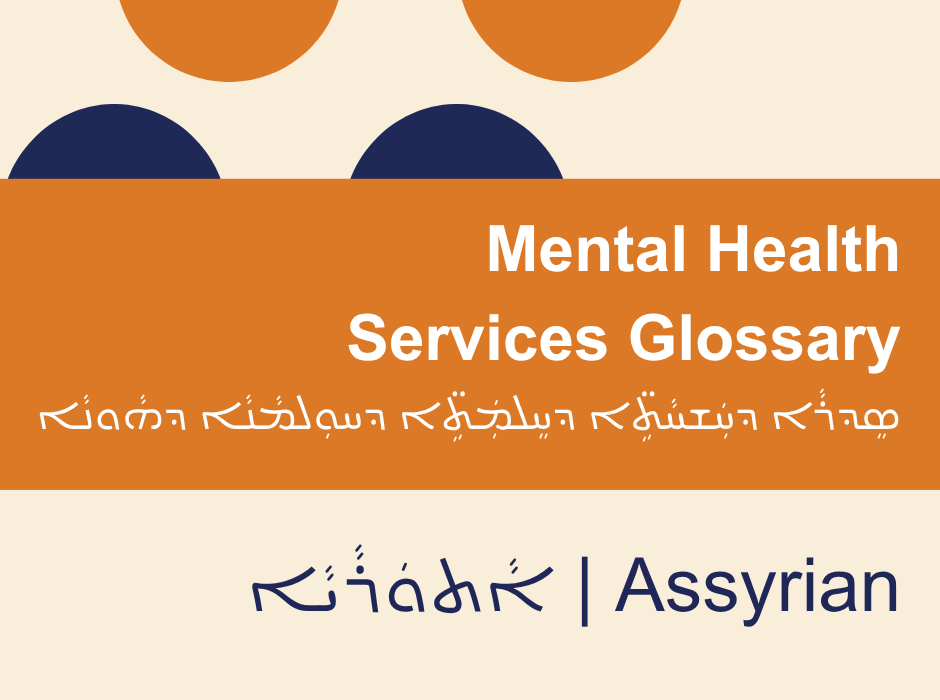
Assyrian | ܐܵܬܘܿܪܵܝܵܐ
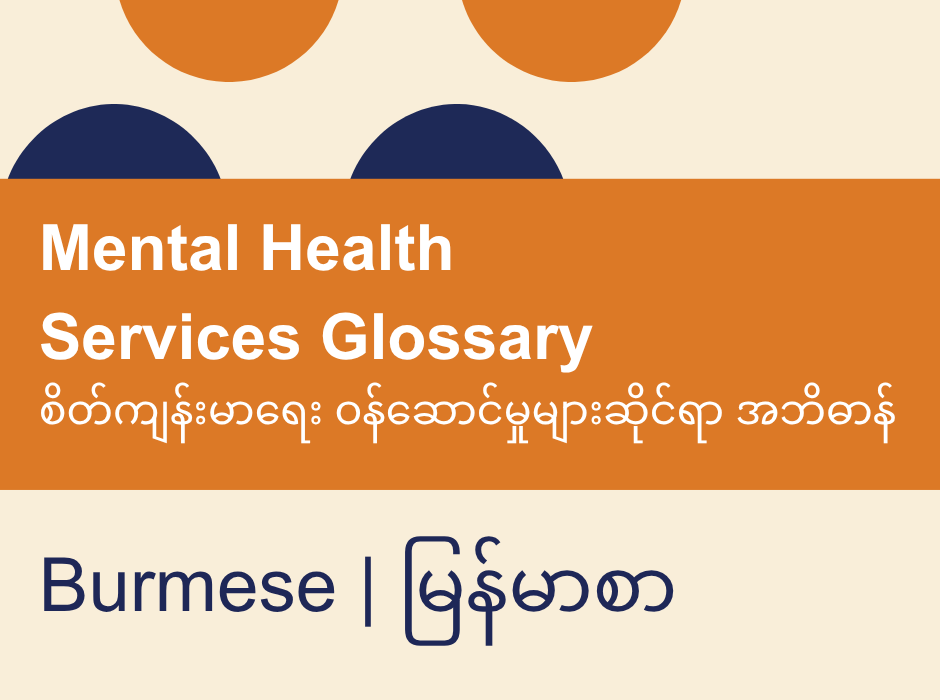
Burmese | မြန်မာစာ
Dari | درى
Dinka | Thuɔŋjäŋ
English
Farsi | فارسى
Hakha Chin | Laiholh
Karen | ကညီကျိာ်
Khmer | ភាសាខ្មែរ
Pashto | پښتو
Rohingya
Swahili | Kiswahili
Tamil | தமிழ்
Tigrinya
Urdu | ارُدوُ
Vietnamese | Tiếng Việt
Looking to promote the Glossary?
Promotional text for social media:
We’re excited to share a new resource by the Victorian Refugee Health Network and the Centre for Culture, Equity and Health, to make mental health information more accessible for multicultural communities in Victoria.
The new Bilingual Mental Health Services Glossary has been translated into 17 languages, helping individuals better understand common terms and feel more confident navigating mental health services.
Language should never be a barrier to getting support. This glossary is a practical step toward more inclusive, culturally responsive care. It can be used as a reference before, during, or after sessions, empowering clients with the knowledge to ask the right questions and make informed decisions about their care journey.
- Understand key mental health concepts
- Navigate services more confidently
- Access information in one of 17 preferred languages
Explore the glossary and share it with your networks.
Help make mental health information clearer, more inclusive, and easier to access for everyone.
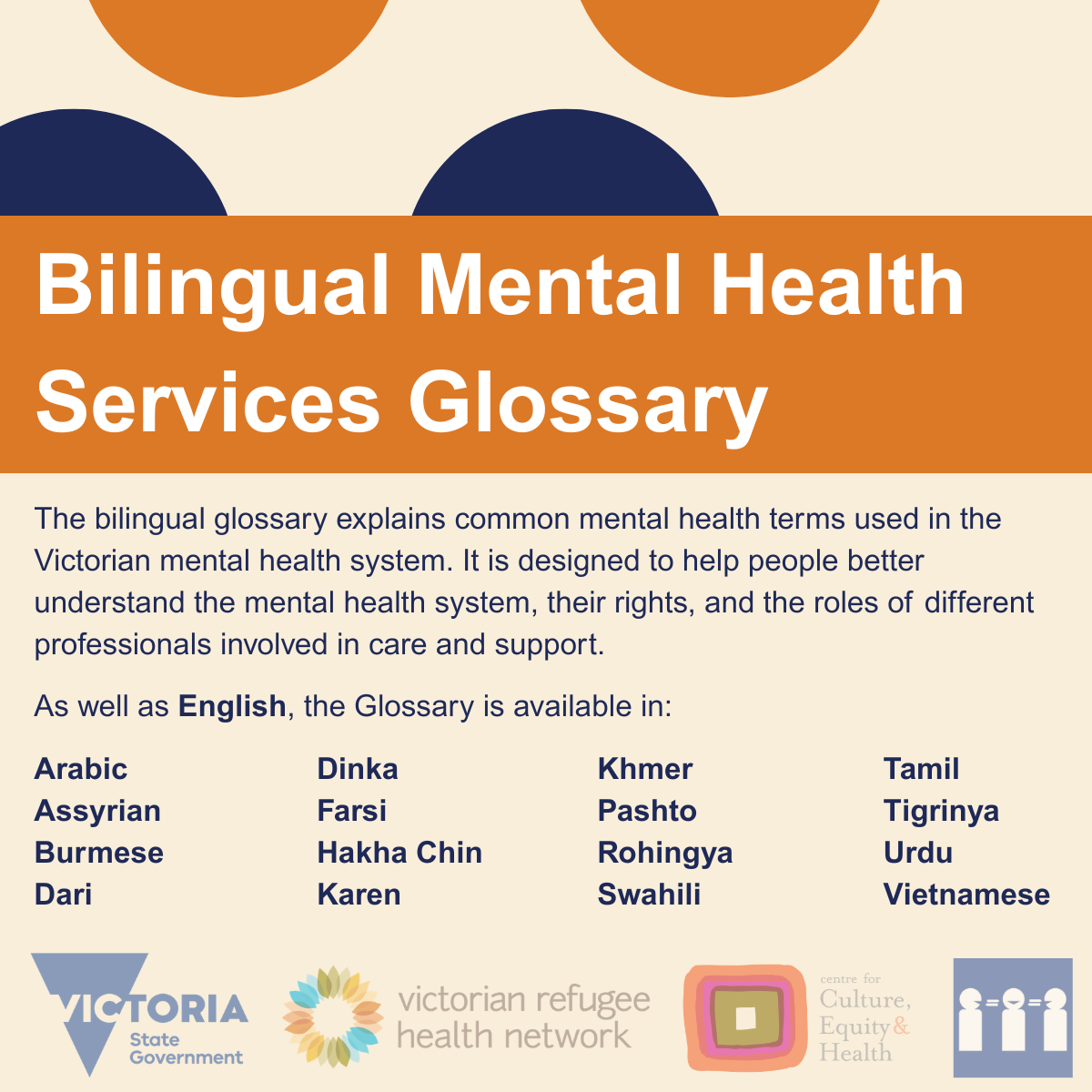
Download Tile 1
Download Tile 2
Download Tile 3
Download Banner
More About the Project
In 2017, the Centre for Culture, Equity & Health (CEH) developed the original version of the bilingual Mental Health Services Glossary. This version included 30 key terms and was translated into seven different languages.
In 2025, the VRHN and CEH commenced a project to update the Mental Health Services Glossary. This update included adding 15 new terms and translating the glossary into more languages. These additional languages were selected based on the most common languages spoken by recently arrived people of refugee backgrounds.
This project was undertaken to improve:
- Communication gaps between mental health practitioners and interpreters when discussing mental health concepts;
- Consistency and accuracy in how mental health terms are conveyed across multiple language groups;
- Understanding of new services and roles in the Victorian mental health system;
The updated Glossary was translated with the help of Polaron, staff from the Victorian Foundation for Survivors of Torture (Foundation House) and community testers. Workshops were held with NAATI accredited interpreters to help promote the use of the glossary.
The Glossary was officially launched in July 2026, and with the help of peak body organisations, will be disseminated throughout the mental health sector, language services, and community groups to encourage widespread use.
This glossary was funded by the Victorian Government Department of Health.
Frequently Asked Questions (FAQs)
How did you decide which languages to translate into?
The Glossary was translated into the languages most commonly spoken by humanitarian entrants to Victoria. This is informed by humanitarian settlement data by the Australian Government Department of Home Affairs.
Can you translate the Glossary into an additional language?
We are always keen to increase the accessibility of our resources. If there is a language you would like the Glossary translated to, please contact us.
Can you add another term to the Glossary?
We have done our best to include 45 of the top key terms for accessing and navigating the Victorian mental health system. The new terms that were added in the 2026 update of the Glossary was informed by the 2021 Victorian Mental Health Reforms. If there are other terms or concepts that you’d like us to consider adding, please contact us at refugeehealth@foundationhouse.org.au and we can explore the possibility.
Who was consulted in the translation process?
The team at Polaron translated each version of the Glossary. Their professional translators are NAATI accredited and are highly aware of cultural and linguistic nuances within the language.
The translation process with Polaron also drew on consultation with colleagues at the Victorian Foundation for Survivors of Torture (Foundation House) and our collaborators at the Centre for Culture, Equity & Health to finally create the documents you see above.
I don’t agree with one of your translations of a term, can you change it?
Please let us know if any of our translations are incorrect. However, we also acknowledge that each translator may have different opinions on the exact translation of a term. We have done our best to combine the voices and opinions of multiple people in our consultation process and feel confident that each term has been considered thoroughly. We encourage you to use the Glossary as a foundation and continue to add your own interpretations as additional information for the client if required.
I live/work outside Victoria (or outside Australia) – can I still use this Glossary?
We encourage widespread use of this Glossary, both inside and outside Victoria! However, these terms have been tailored to service clients within the Victorian mental health system, and some terms will not be relevant outside of Victoria. For instance, “Mental Health and Wellbeing Locals” are a Victorian initiative not yet mirrored interstate. Please therefore be aware when interpreting directly from our translations to ensure the terms are still appropriate for your needs.
For other enquiries, please email us at refugeehealth@foundationhouse.org.au
For more information
If you are interested in learning more about how the Glossary was created or how it can be used, please contact the Victorian Refugee Health Network at refugeehealth@foundationhouse.org.au
Gavin Halge
Refugee Health Network Coordinator
E: halgeg@foundationhouse.org.au